
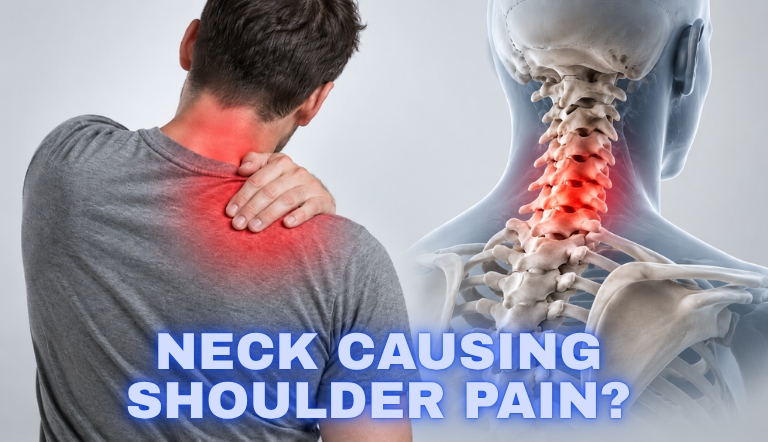
Upper back pain or pain across the upper shoulder does not always originate where you feel it. In some cases, discomfort around the upper trapezius, shoulder blade, or upper back can be referred from joints in the cervical spine, or neck. This means that repeatedly treating the painful area may provide temporary relief without addressing the region contributing to the pain.
The joints in the neck, including the cervical facet joints, can produce recognizable referral patterns. Irritation involving different levels of the cervical spine may be experienced as pain in the head, neck, upper shoulder, trapezius region, or around the shoulder blade. The painful area and the source of the pain are therefore not always the same place.
This is why persistent upper back or shoulder pain should be properly assessed rather than treated based only on where it hurts. When the neck is contributing to the symptoms, identifying the involved spinal region and addressing the associated biomechanical problem may be an important part of care.
For patients in Vaughan, Ontario who have already tried treatment directed at the upper back or shoulder without lasting improvement, examining the cervical spine can provide additional information about why the discomfort continues.
Many people naturally assume that if their upper back hurts, the problem must be located in the upper back. If the shoulder feels tight or painful, they may assume that the shoulder muscles themselves are responsible.
That assumption is understandable. The painful area often feels tender, tight, or irritated, so it seems logical to work directly on it.
Patients may therefore try massage therapy, physiotherapy, acupuncture, cupping, medication, or other approaches focused specifically on the area where they feel their symptoms. These approaches may sometimes reduce discomfort. However, if the pain is being referred from a cervical spinal joint, repeatedly treating the upper back muscles alone may not address the contributing source.
This distinction can be particularly important when pain keeps returning or when an area has been treated repeatedly without the expected improvement.
As a corrective care chiropractor in Vaughan, Ontario, Dr. Walter Salubro evaluates more than the location of the symptoms. The examination process looks at the spine, muscles, posture, and other clinical findings to determine whether the neck may be contributing to pain that is being experienced somewhere else.
Why Neck Problems Can Cause Upper Back, Shoulder, and Head Pain
The cervical spine consists of multiple vertebrae and joints that allow the neck to move while helping support the head. At the back of the cervical spine are small joints commonly referred to as facet joints.
These joints are surrounded by joint capsules containing tissues that can become irritated. When structures associated with a cervical facet joint produce pain, the sensation does not necessarily remain directly over that joint.
Instead, the pain can sometimes be referred to another region.
The referral patterns discussed in Dr. Walter Salubro’s video come from research published in the Spine journal in 1990. In the first part of the research described in the video, investigators stimulated cervical facet joint capsules in participants who did not have existing clinical symptoms such as neck pain, upper back pain, shoulder pain, or headaches.
The participants were then asked where they experienced the resulting discomfort.
The important finding was that pain was not always felt directly over the stimulated cervical joint. Different cervical levels produced pain in different regions of the head, neck, shoulder, and upper back. Researchers were able to map these patterns according to the cervical joint being stimulated.
This helps explain an important clinical principle: where you feel pain does not automatically identify where the pain begins.
For someone experiencing ongoing shoulder blade pain or upper trapezius pain in Vaughan, Ontario, this means that evaluating only the painful muscle may provide an incomplete picture.
Upper Cervical Joints and Head Pain
The upper cervical spine can be associated with referral patterns into the head.
According to the referral patterns discussed in the video, the uppermost cervical joint regions can refer discomfort toward the back or side of the head and into the suboccipital region, which is the area just beneath the skull.
For example, irritation associated with the upper cervical facet regions may be experienced as pain around the back of the head rather than as obvious neck pain.
This is one reason a patient describing head pain may still require an examination of the upper cervical spine.
It does not mean every headache originates in the neck. Headaches can have many possible causes, and appropriate evaluation is important. However, when the clinical pattern suggests cervical involvement, the upper neck should not automatically be overlooked simply because the most noticeable symptom is located in the head.
Dr. Walter Salubro, a corrective care chiropractor in Vaughan, Ontario, uses examination findings to determine whether cervical misalignments may be contributing to the patient’s pain pattern rather than assuming that every symptom has the same cause.
Mid-Neck Pain and the Middle Cervical Spine
Pain that remains more centrally located in the neck may correspond with the middle cervical facet regions.
The video describes referral patterns associated with the C3-C4 and C4-C5 cervical levels as being more closely related to pain through the middle portion of the neck.
For a patient, this can feel more intuitive because the symptom and the potential source are located relatively close together.
However, even in these cases, simply treating tight muscles may not provide the complete answer if joint mechanics and spinal alignment are contributing to irritation.
This is where examining how the cervical spine is positioned and moving becomes relevant.
Muscle tightness can develop alongside altered spinal mechanics. Treating muscle tension may make the area feel temporarily better, but a corrective assessment asks another question: why is the region continually becoming irritated?
Lower Neck Referral Into the Upper Shoulder and Trapezius
One of the most clinically relevant referral patterns for people with upper shoulder discomfort involves the lower cervical spine.
As explained in the video, the C5-C6 cervical joint region can refer pain toward the upper trapezius area. This is the muscular area running from the lower neck toward the top of the shoulder.
A patient may feel as though there is a knot or persistent painful point around the upper shoulder. Because that is where the discomfort is located, treatment may repeatedly focus on loosening or working on the trapezius muscle.
Sometimes that approach helps.
But when symptoms continue despite repeated local treatment, it becomes reasonable to investigate whether another area may be contributing.
If irritation involving a lower cervical facet joint is referring pain into the upper trapezius, the muscle is where the patient experiences the symptom, but it may not represent the full source of the problem.
This is why Dr. Walter Salubro’s examination process in Vaughan includes evaluating the cervical spine rather than focusing exclusively on the site of pain.
C6-C7 and Pain Around the Shoulder Blade
Pain around the shoulder blade is another symptom that patients commonly describe as upper back pain.
A person may point directly to an area along or near the scapula and say that this is where the problem has been for weeks, months, or longer.
According to the cervical referral patterns described in the video, irritation associated with the C6-C7 facet region may refer discomfort into the scapular area.
This can create a frustrating cycle.
The patient feels pain around the shoulder blade. Treatment is applied around the shoulder blade. The area may loosen temporarily, but the pain eventually returns. More treatment is then directed toward the same location because that is still where the patient feels the discomfort.
If the neck has never been examined, an important potential contributor may have been missed.
This does not mean all shoulder blade pain is cervical in origin. Muscles, joints, the shoulder, ribs, and other structures may also contribute to symptoms in this area. The point is that persistent pain should be investigated rather than automatically assumed to originate exactly where it is felt.
Why Treating Only the Painful Area May Not Be Enough
Local treatment can be useful for reducing muscle tension and improving comfort. However, symptom relief and correcting a contributing mechanical problem are not necessarily the same thing.
Massage, acupuncture, cupping, medication, and similar approaches may sometimes reduce the intensity of pain. In the context described in the video, however, they may not correct a cervical biomechanical problem that is contributing to a facet referral pattern.
Think of the painful area as a signal.
If the signal is coming from another region, repeatedly treating the location receiving the signal may not change what is generating it.
That is why identifying the underlying pattern matters.
Dr. Walter Salubro frequently sees patients in his Vaughan chiropractic practice who describe upper back or shoulder discomfort despite having already received care focused on the painful area. When examination reveals tenderness or dysfunction around a cervical facet region that matches the patient’s referral pattern, the clinical focus may shift toward addressing the neck.
In some cases described by Dr. Salubro, patients experience improvement in the upper back region even though treatment is not being applied directly to the painful upper back area.
The purpose is not to chase the pain. It is to investigate what may be contributing to it.
How Cervical Referral Patterns Help Guide Clinical Reasoning
The research discussed in the video did more than document where pain was experienced after stimulation of cervical joints.
In the second part of the study, researchers examined whether the mapped referral patterns could help identify which cervical joints were involved in patients who already had clinical pain.
The patterns were found to have predictive clinical value.
For example, if someone described pain in the upper shoulder region, clinicians could investigate cervical areas known to refer pain toward that location. If someone reported discomfort in the middle portion of the neck, the middle cervical facet joints could be assessed.
This does not mean that a pain map alone can diagnose the cause of someone’s symptoms.
Instead, it provides another piece of clinical information.
Symptoms, examination findings, tenderness, posture, spinal mechanics, and other relevant findings must be considered together.
That is why an assessment is different from simply looking at a diagram and assuming that a particular cervical joint must be responsible.
What Happens During a Corrective Chiropractic Assessment in Vaughan
When someone visits Dr. Walter Salubro for persistent neck, upper back, or shoulder pain in Vaughan, Ontario, the process begins with a consultation.
Understanding the patient’s history matters because two people pointing to the same painful area may have very different contributing factors.
The examination then includes evaluation of the spine, muscles, and posture.
Dr. Salubro also describes using spinal X-rays when clinically appropriate as part of determining whether structural or biomechanical findings may relate to the patient’s symptoms.
The goal is to collect information rather than make assumptions based only on the pain location.
For example, a patient may describe pain around the shoulder blade. During examination, a cervical region may also be tender or mechanically altered. The patient’s posture may show a forward head position or another cervical alignment change. Imaging may provide additional information about the structure of the cervical spine.
Taken together, those findings can help determine whether a cervical contribution should be addressed.
Corrective Chiropractic Care and Cervical Biomechanics
Dr. Walter Salubro practices corrective care chiropractic and Chiropractic BioPhysics techniques in Vaughan, Ontario.
The corrective approach described in the video focuses on identifying biomechanical distortions and applying procedures intended to improve spinal mechanics.
Cervical alignment patterns discussed in the video include forward head posture, military neck, and cervical kyphosis.
A healthy cervical spine normally has a characteristic alignment. Changes in the position of the head or shape of the cervical curve can alter how forces are distributed through the neck.
When cervical biomechanics are altered, joints and surrounding tissues can potentially experience different mechanical stresses.
Corrective chiropractic care therefore focuses on more than temporarily reducing pain. The clinical goal described by Dr. Salubro is to evaluate the spinal mechanics associated with the patient’s symptoms and apply appropriate corrective procedures when indicated.
This may include specific chiropractic adjustments directed toward identified spinal regions along with other corrective care procedures.
The precise approach depends on the patient’s examination findings.
Why Specificity Matters When Addressing Referred Pain
Referred pain reinforces why treatment should be specific.
If a patient feels discomfort near the shoulder blade but examination findings point toward a cervical contribution, repeatedly treating the shoulder blade alone may not address the complete problem.
Conversely, not every case of shoulder blade pain should automatically receive cervical treatment.
The determining factor should be the examination.
Clinical reasoning involves comparing the patient’s symptoms with objective findings and deciding whether the pattern makes sense.
This is also why Dr. Walter Salubro emphasizes examining the spine, muscles, posture, and other relevant factors before beginning corrective care in his Vaughan chiropractic practice.
The objective is to identify a plausible relationship between what the patient feels and what the examination reveals.
When to Seek Professional Care
Persistent upper back, upper shoulder, neck, scapular, or headache symptoms should be professionally evaluated when they are not improving, repeatedly return, or do not respond as expected to treatment directed at the painful area.
This is especially relevant when no one has evaluated the cervical spine.
A professional assessment becomes important because several structures can create similar symptoms. Pain near the shoulder blade, for example, does not automatically confirm a cervical facet problem. A clinician must determine whether the neck is involved and whether the patient’s findings are consistent with a cervical referral pattern.
Dr. Walter Salubro is a corrective care chiropractor in Vaughan, Ontario who evaluates spinal mechanics, muscles, posture, and cervical alignment when determining whether the neck may be contributing to upper back or shoulder symptoms.
Assessment and clinical reasoning matter because treatment should be based on findings rather than simply on the location where pain is felt.
If a patient has repeatedly treated the painful upper back or shoulder area without improvement, evaluating the cervical spine may provide information that has previously been overlooked.
Nightly and Weekly Action Plan
If you have recurring upper back, shoulder, neck, or shoulder blade pain, start by paying attention to the pattern rather than repeatedly pressing, stretching, or treating the painful spot.
Notice where the pain begins, where it travels, whether it changes with neck movement, and whether it consistently returns to the same region. This information can be useful during a professional assessment.
Avoid assuming that a painful shoulder or upper back automatically means the shoulder or upper back is the only area involved. Likewise, do not assume that a referral map can diagnose your condition on its own.
During the week, consider how often the symptoms return despite treatments focused directly on the painful region. If the pain repeatedly comes back, that pattern is useful clinical information.
The appropriate next step is an assessment that looks at the cervical spine along with the symptomatic region so the potential source can be investigated.
For patients in Vaughan, Ontario, Dr. Walter Salubro’s corrective chiropractic approach includes evaluating spinal alignment, posture, muscles, and cervical biomechanics to determine whether referred pain patterns may be involved.
Final Thoughts
The most important lesson is simple: pain does not always originate where you feel it.
Upper back pain may sometimes be related to the cervical spine. Upper trapezius discomfort may potentially correspond with lower cervical referral patterns. Pain around the shoulder blade can also be associated with cervical facet referral patterns. Some pain in the back or side of the head may be connected with the upper cervical region.
This does not mean every case has the same explanation. It means persistent symptoms deserve investigation rather than repeated assumptions.
When treatment has been directed toward the painful region but the problem keeps returning, examining the neck may reveal a contributing factor that has not previously been considered.
Correct identification of the possible source matters because effective care depends on understanding what is contributing to the symptoms rather than simply chasing the location of pain.
If you are experiencing persistent upper back, shoulder blade, upper shoulder, or neck pain in Vaughan, Ontario and previous treatment focused on the painful area has not resolved the problem, consider having your cervical spine properly evaluated.
Contact Dr. Walter Salubro, Corrective Care Chiropractor in Vaughan, Ontario, to arrange an assessment and determine whether cervical spinal mechanics may be contributing to your pain pattern.
Frequently Asked Questions
Q: Can neck problems cause upper back pain?
A: Yes. As explained by Dr. Walter Salubro, certain cervical facet joints can produce referred pain patterns that are felt in the upper back, trapezius, shoulder blade, or other nearby areas. This means the area where you feel pain may not always be the location generating the pain. A clinical examination is needed to determine whether the cervical spine is contributing in an individual case.
Q: Can pain around my shoulder blade actually come from my neck?
A: It can. Referral patterns described in cervical facet research and discussed in Dr. Salubro’s video show that lower cervical joints, including the C6-C7 region, can refer discomfort toward the scapular or shoulder blade area. However, shoulder blade pain can have other causes, so a proper assessment is important before deciding where treatment should be directed.
Q: Why is my upper back pain not improving with massage or other treatments?
A: There can be many reasons. One possibility is that treatment has been focused primarily on the area where the pain is felt while another region is contributing to the symptoms. If the cervical spine is generating referred pain into the upper back or shoulder, working only on the symptomatic muscles may not address the complete problem. Dr. Walter Salubro evaluates the cervical spine as part of determining whether this type of referral pattern is present.
Q: What part of the neck can refer pain into the upper shoulder?
A: The referral patterns discussed in the video associate the lower cervical region, particularly around C5-C6, with pain into the upper trapezius or shoulder region. C6-C7 referral patterns can extend more toward the scapular area. These maps can help guide an examination, but they should not be used as a diagnosis without a clinical assessment.
Q: How does a chiropractor in Vaughan determine whether my neck is causing my upper back pain?
A: Dr. Walter Salubro begins with a consultation and examination that may include assessment of the spine, muscles, posture, tenderness, and spinal mechanics. X-rays may also be used when clinically appropriate to evaluate cervical alignment. The findings are then compared with the patient’s symptoms and referral pattern to determine whether the neck may be contributing.
Q: Where can I have persistent upper back or shoulder pain assessed in Vaughan, Ontario?
A: If your upper back, shoulder blade, upper trapezius, or neck symptoms continue despite treatment focused on the painful area, Dr. Walter Salubro, Corrective Care Chiropractor in Vaughan, Ontario, can assess whether cervical spinal mechanics and referred pain patterns may be contributing. Contact Dr. Walter Salubro’s office in Vaughan to arrange an evaluation and discuss the appropriate next steps for your individual findings.
Dr. Walter Salubro
Back To Health Chiropractic Centre
Corrective Care Chiropractor in Vaughan, ON
20 Cranston Park Ave, #6
Maple, ON L6A 2W2
Tel: (905) 303-1009
